Continuing on the last post, I said although some earnings number are not pretty, Jumia has become a different firm in two year.
It was relying heavily on first-party sales (“resell” model like JD.com) which accounted for over 70% of its revenue in 2018Q1. That number decreased overtime to 34% in 2020Q1 (halved), partially due to the coronavirus disruption from Jumia’s own suppliers.
Another way to look at this is on the GMV level. 1st party revenue as % of GMV decreases overtime as well – what is more, the take-rate on the rest of the GMV, where marketplace revenues come from, is improving.
I do believe marketplace revenues (like Alibaba) are more valuable. Thus, Jumia’s has grown its higher-quality revenue overtime. The third-party business has shaped Jumia into a different company (with more valuable revenues).
As JumiaPay keeps growing, it will deliver value just like Alipay.
Another important matrix that is improving significantly is gross profit after fulfillment expense. This value could be used as “gross profit” or even “revenue” to better track the long-term profitability.
Fulfillment expense is not trivial and grows with the GMV as both 1st-party and 3rd-party sales uses Jumia’s delivery network.
And as mentioned in the previous post, African nations are now more willing to use mobile payments due to coronavirus. The improvement in adoption will give Jumia a boost in monetization overtime.
To sum up, three reasons that I believe Jumia is a different company:
higher-quality marketplace revenues are now driving the growth
gross profitability after fulfillment improves meaningfully
pandemic-shaped population will adopt mobile payments & fintech solutions much more easily – trust is forced to build.
On May 13, Jumia reported its 2020 Q1 earnings, which also provides a glimpse into African cities under coronavirus.
Source: Google
The market didn’t react positively after the earnings, but some opportunistic expectations had been built in before.
Although some numbers are not ideal and growth seems lackluster, I would argue in the next blog that Jumia has become a very different company than two years ago.
This post summarizes things that appear to be positive for Jumia, from its Q1 earnings and the shareholder letter in April, among other communications:
Partnership with Reckitt Benckiser, a global health products manufacturer selling through Jumia, is financing free shipping nationwide (8 markets that Jumia operates) on all listed products; Jumia takes 0% commission. -> free marketing / user acquisition that ensures a good first online shopping experience; keep logistics team operate
Focusing on contactless delivery options & online payments. -> accelerating JumiaPay adoption when cash is still considered important; building trust, also encouraged by governments
Providing affordable basic foods and sanitary essentials. -> shaping perception on online shopping to everyday purchases
In South Africa, it launched Jumia platform with an assortment of essential products (Reckitt Benckiser and P&G) that can be delivered despite the lockdown (was selling fashions via Zando which is shut down).
Jumia Food pivots to grocery delivery
Increased demand from sellers to join the Jumia platform as offline distribution channels are largely disrupted – high-profile brands on Jumia Mall, including Coca-Cola and Nigerian Breweries in Nigeria, PepsiCo and Nivea (Beiersdorf) in Egypt.
Launched JumiaPay in Tunisia
Consumers can purchase game subscriptions or credit for in-app purchases on the JumiaPay app for popular games
Advertising services were available across 9 out of 11 countries, compared with 5 at the end of 2019 – in Q1 run campaigns for high-profile brands including Adidas, L’Oreal, Microsoft, Sensodyne and Mondelez
Volumes surged in some markets, such as Morocco and Tunisia, while limited in countries such as South Africa and Nigeria
The countries that have been the most severely affected by confinement measures have experienced a gradual volume recovery since mid-April, while the countries that saw a surge in volumes continued to experience robust momentum throughout April. Overall, in terms of items sold, we ended the month of April c.3% above the first week of March levels.
Jumia will use its infrastructure which includes riders trained to provide safe and contactless deliveries, to provide a platform for the vendors to reach customers who are currently under lockdown.
Consumers will have the option of giving feedback on the level of satisfaction of both the product and the service through the Jumia Vendor App.
Jumia and Mastercard announced a partnership to incentivize the use of cashless payments platforms – consumers who purchase essential products using their Mastercard on the Jumia platform will receive up to a 10 per cent discount on their order
Things that are implying negative developments:
The early signs of the COVID-19 disruption were felt in our cross-border operations as a result of manufacturing facility shutdowns in China. Supply chain disruption in China also impacted our local sellers, many of whom source their goods from China.
Different forms of confinement measures have been affecting operations to varying degrees, food delivery business, brief closures of warehouse, sellers’ inability to deliver, etc.
Currently expect continued GMV weakness over at least the first half of 2020, with better Order and Annual Active Consumers growth, on a year-over-year basis.
While railway and steamship are useful in long distance delivery, short distance and city delivery system was still relying on manpower and horsepower. Things started to change in the 20th century.
In December 1899, an automobile mail wagon was tested in the US for the first time. Officials cheered the dramatic increase in collection speed and soon postmasters across the country were testing motorized vehicles. Collection times were cut at least in half in most trials. [PostalMuseum]
Driving was not an everyday skill in the early 20th century, so the Post Office asked manufacturers and suppliers to provide drivers along with the vehicles.
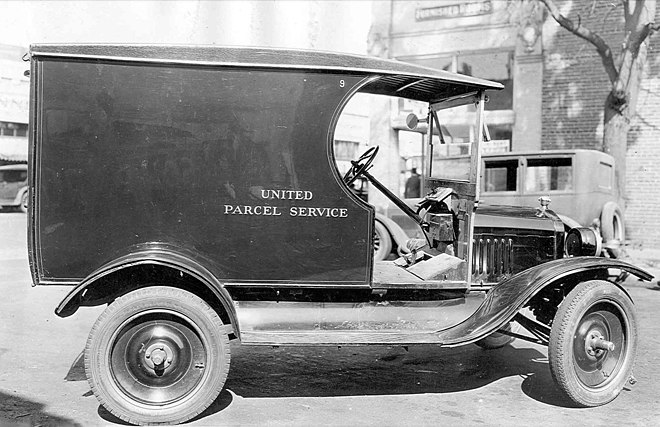
UPS bought its first car, a 1913 Model T Ford, and attached a truck bed to its back. By 1915, it was using four autos and five motorcycles, and employing 20 foot messengers.
Ford Model T UPS delivery vehicle in 1921 | Source: Wikipedia
In 1919, it started to use the current name UPS.
After WWII
During the Great Depression of the 1930s and America’s involvement in World War II from 1941–1945, new truck purchases were a low priority at the Post Office Department. As a result, trucks bought in the 1920s and early 1930s were kept on the road longer than expected. [PostalMuseum]
Fueled by the boom of the auto industry, industrialization again revolutionized the delivery system and further expanded the ability of settlement in less connected lands across the US.
Post war, the family car played a central role in suburban life; the number of cars on the road increased from 25.8 million in 1945 to 61.7 million by 1960. America’s growing dependence on automobiles and the growth of the suburbs pushed the Post Office Department to change how it transported and delivered mail. Passenger trains — which had transported most mail since the 19th century — declined, as more and more people chose the open road over the railroad. [USPS]
The first Highway Post Office bus was inaugurated on February 10, 1941. A second route was not established until 1946 due to the outbreak of World War II.
Highway Post Office Bus | Source: postalmuseum
Highway Post Office routes were organized on round trips which averaged about 150 miles each way. There was a very good reason for this, as the bus generally could only hold enough gas for about one 150 mile trip, and fuel stops meant losing valuable time.
Three-wheeled vehicles like Mailster were tested in half a dozen cities beginning in June 1950. By the end of the decade, more than 5,700 Mailsters were in service; the number peaked in 1966, at about 17,700 nationwide.
Postal system has its political importance, which is why it’s included in the constitution. As the US expanded, how information / news / mails were transmitted were directly influencing the limit of a united society.
On July 7, 1838, Congress declared all railroads to be post roads and enabled the railways to make contracts as long as sending mail by rail cost no more than 25 percent above transporting it by stagecoach.
But it’s the industrialization that enabled the US to include / connect California and other lands that are far away from the initial states.
In 1848, US acquired California at the end of the Mexican War. Under the Treaty of Guadalupe Hidalgo, Mexico also recognized the U.S. annexation of Texas, and agreed to sell California and the rest of its territory north of the Rio Grande for $15 million plus the assumption of certain damages claims.
In November 1848, Postmaster General Cave Johnson dispatched a special agent to California to establish Post Offices. By Christmas, steamships were carrying mail from New York to California via the Isthmus of Panama. This was before the construction of the canal. When the ships reached Panama, the mail was taken off and transported in canoes or on pack animals – and later by railroad – about 50 miles to the Pacific coast. Another steamship collected the mail on the Pacific side and headed north.
The first U.S. Mail traveled to California by steamship, via the Isthmus of Panama, in 1848 | Source: USPS
Congress authorized funding for the overland routes not because they brought any financial profit to the Post Office Department or the federal government, but because they helped build and bind together a nation.
Also briefly mentioned in 一朝风雨一代王:Sears, Walmart, Amazon, the expansion of the US rail transportation contributed to the growth of USPS (Post Office Department at the time).
Source: gorhistory.comSource: gorhistory.com
In 1862, mail was sorted en route, as a train moved between two points, using converted baggage cars.
By the early 1900s, railroads were critical to postal operations. Like Union Station in Washington, D.C., located adjacent to the City Post Office Building, the Post Office Department ordered that all new main post offices in large cities be built as near as possible to the principal railroad station.
… expanded the scope of JumiaPay beyond our physical goods marketplace. As of December 31, 2018, JumiaPay was only available within our physical goods marketplace. It is now also available within our on-demand services, Jumia Food, and hotel booking portals, Jumia Travel, in selected countries.
…we continued to expand the range of financial and digital services available from third parties, powered by JumiaPay, offering our consumers an increasing range of relevant every day services.
In Nigeria for instance, consumers can now access micro-loans offered
by a local fintech startup, alongside event tickets offered by a local event ticketing provider.
In Egypt, in the second quarter of 2019, we started distributing services from a local deals provider allowing consumers to purchase their vouchers on the Jumia platform, using JumiaPay.
Not surprisingly, 2019 has been a good year for JumiaPay, with quarterly TPV ( Total Payment Volume) growing constantly and annual TPV of ~€124 million.
TPV as a percentage of Jumia’s GMV, grew from 8.6% in 19Q1 to 15.1% in 19Q4. (update: GMV before adjustment)
Meanwhile, the value per transaction on JumiaPay is lower than its value per order on Jumia, which makes sense as JumiaPay is more user in every day purchases.
In 19Q4, €19 per transaction is roughly half of the Jumia order value (€36).
JumiaPay provides a hyper-growth opportunity.
In the Q4 press release, it says “the ramp-up of JumiaPay on-platform is attributable to our continuous education efforts of consumers, the expanding range of digital services offered as part of our JumiaPay app as well as a number of newly introduced marketing initiatives. These include Mastercard Tuesdays discounts, cash-backs funded by card issuing banks or the possibility to pay for purchases in 12-month installments at no interest, offered by partner banks. “
Despite YouTube’s ubiquity and its role as a public-facing platform, it remains a private forum, not a public forum subject to judicial scrutiny under the First Amendment
– Circuit Judge M. Margaret McKeown
Dots to connect: internet platforms’ products that operate like government, possible platforms with political views, regulation vs. indirect influence on tech firms, etc.
Below is the chart for Jumia’s performance in terms of GMV.
A spike in 2018Q4 just before IPO is controversial..
Although with the “artificial” growth in 18Q4, the trend looks good
The more worrying part is the slowdown in GMV growth – especially when Jumia is still has a long way to go
Jumia’s full year 2019 GMV is €1.1 billion, up 33% compared to 2018.
Comparatively, Pinduoduo’s GMV in the twelve-month period ended December 31, 2018 was RMB471.6 billion (US$268.6 billion), an increase of 234% from RMB141.2 billion in the twelve-month period ended December 31, 2017.
Combined with Jumia’s annual active customer base, we can see the GMV per AAC declining over time.
In its Q4 press release, Jumia says “we have reduced promotional intensity and consumer incentives on lower consumer lifetime value business. While most product categories experienced GMV growth in the 20 to 50% range, phones and consumer electronics contracted by approximately 20% on a year-over-year basis. This aspect of the business mix rebalancing will likely continue to negatively impact GMV development over the next two quarters.”
Source: Jumia 2019Q4 Presentation
“…we have increased our focus on everyday product categories such as Fast Moving Consumer Goods (“FMCG”), fashion, beauty and personal care as well as digital services which provide affordable entry points into the Jumia ecosystem…”
We could also see that Pinduoduo’s GMV per active buyer is a little bit insane..
approx. annual GMV per active buyer = $268.6 billion / 418.5 million = $641.8
Jumia is at ~€180 in 2019, using annual GMV divided by ending AAC.
To compare it with consumers’ e-commerce purchase across the globe..
Jumia was offering 13,500,000 ADR shares with an IPO range of $13 to $16 per share and priced at $14.5 per share.
Mastercard Europe SA has agreed to purchase €50.0 million of shares in a concurrent private placement at the same price.
As of December 31, 2018, Mobile Telephone Networks Holdings (Pty) Ltd (“MTN”), Rocket Internet SE (“Rocket”) and Millicom International Cellular SA (“Millicom”) own respectively 31.28%, 21.74% and 10.15% of the Company.
Other shareholders are AEH New Africa eCommerce I GmbH (8.86%), AXA Africa Holding SAS (6.06%), Atlas Countries Support S.A. (6.06%), Chelsea Wharf Holdings S.à r.l. (5.51%), CDC Group (4.04%), Rocket Investment Funds (3.48%) and Goldman Sachs (2.83%).
Africa has one of the most digitally connected populations on the planet, with 400 million internet users.
Comparatively, say China has three times the number of internet users (1.2bn), Jumia would have 12 million or 18.3 million respectively.
Pinduoduo, a relatively new e-commerce platform in China, said its Active buyers in the twelve-month period ended December 31, 2018 were 418.5 million, an increase of 71% from 244.8 million in the twelve-month period ended December 31, 2017.
We are talking about totally different stages of e-commerce. Low penetration means more education and infrastructure are needed while potential upside is large.
In the future where Fintech firms dominate, established companies are reacting with three main strategies:
Cut costs for legacy business lines – like what we said in a previous post Banking Headcount Cut
Consolidate with other legacy companies to gain more market share and thus more say/power, further cutting expenses and trying to get more economy of scale – like what we said in the last post From TD Ameritrade To E-Trade: A Wave Of Consolidation
Acquire Fintech startups or replicate what they are doing – like the title of this post Buy & Be FinTech
Plaid is a Fintech firm that enables a lot of other Fintech apps & digital transaction based businesses, providing underlying APIs. It counts Venmo, Robinhood, Coinbase, Acorns, etc. as customers.
Credit Karma lets people check their credit scores, shop for credit cards and loans, file taxes and more. It had close to nearly $1 billion revenue in 2019, growing at 20%.
The company started out originally in 2007 providing free credit scores, later extending that to full credit reports. Credit Karma’s launch of a financial planning tool in 2013 drew a direct comparison to Intuit’s Mint. And since then, Credit Karma has launched other products that directly rival Intuit, for example a free tool to help people file their taxes. These not only represented direct competition, but a disruptive threat, since Credit Karma’s products skewed younger and were built on a “free” premise (offering the products at no charge and instead making money off showing users and selling relevant, related products). The fact that Credit Karma partners with so many other financial services providers also means it’s sitting on a huge data trove that it leverages to build and personalize products, representing a data science angle for Intuit here, too. [TechCrunch]
Meanwhile, besides the notable acquisitions of Fintechs, companies are building similar services by themselves.
By mimicking the experiences/apps offered by startups, established players are essentially becoming Fintechs themselves, thus evolving internally and embracing the future more positively.