The crowd is right 80% of the time.
Contrarianism is useful but overrated as a concept.
The crowd is right 80% of the time.
Contrarianism is useful but overrated as a concept.
David Tepper was a prominent China bull in 2024.
What happened afterwards? Seem that he has been selling continuously and has mostly exited. His recent add in Baidu is still smaller than his other China sales.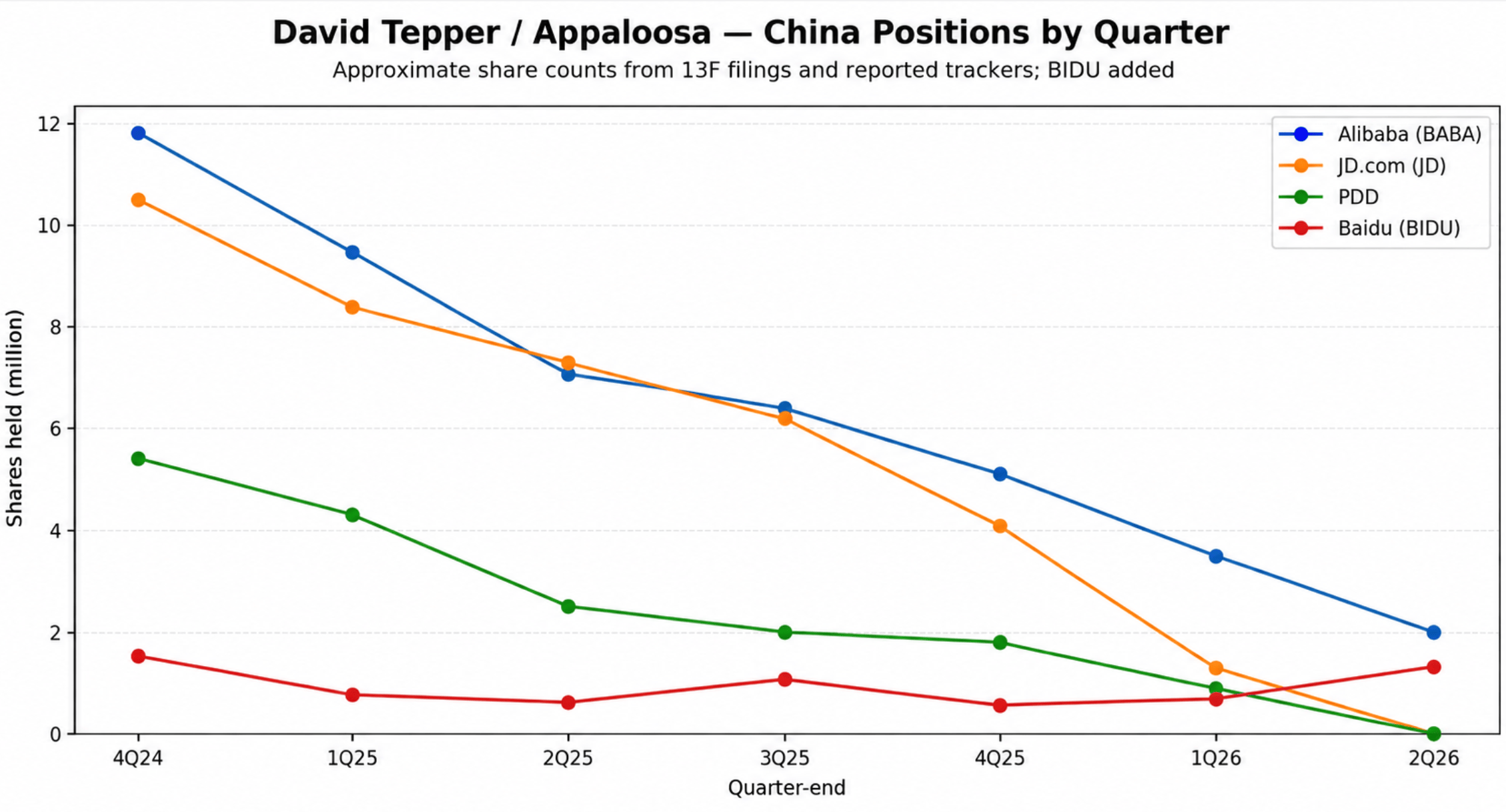
Ray Dalio / Bridgewater similar, even faster exit.
| Position | 4Q24 shares | 1Q25 shares | 2Q25 | Latest 2Q26 |
|---|---|---|---|---|
| BABA | 0.255m | 5.660m | 0 | 0 |
| PDD | 1.247m | 1.743m | 0 | 0 |
| BIDU | ~0.197m | 2.076m | 0 | 0 |
| JD | 0 | 2.787m | 0 | 0 |
| FXI | 1.082m | 0.691m | 0 | 0 |
| KWEB | no meaningful disclosed position | — | — | — |
Source: ChatGPT
Li Lu / Himalaya is more of a long term investor. He recently added PDD and TME.

From March to July, Beijing, Shanghai, Shenzhen housing price has increased for 5 consecutive month in 2026, and Aug is expected to be another strong month.

This resembles the market after 924 in 2024, although that fell short of entering yoy positive territary.
Alibaba now tops the list with 80bn HKD financing.
| 排名 | 公司 / 时间 | 规模 | 关键 Terms | HKEX 官方公告 |
|---|---|---|---|---|
| 1 | 阿里巴巴 9988 8/23交易,8/24公告 | HK$80.0bn | 710m新股;HK$112.70;较参考股价折价约3.6%;扩大后占股本3.57%;net约HK$79.7bn;预计8/26交割。 | HKEX 配售条款公告 |
| 2 | 中际旭创 3308 7/30上市 | HK$53.410bn | IPO 54.5m股 × HK$980;net HK$52.891bn;另有8.175m股绿鞋,但该HK$53.41bn数字未计绿鞋。 | HKEX 最终发售价及配发结果 |
| 3 | 宁德时代 3750 4/28 | HK$39.190bn | 配售 62.385m H股 × HK$628.20;较前收折价7.0%,较5日均价折价10.46%;扩大后稀释约1.36%。 | HKEX 配售条款公告 |
| 4 | 智谱 2513 7/9 | HK$31.411bn | 最多 19.78m H股 × HK$1,588;较前收折价12.99%,较5日均价折价6.72%;扩大后约4.25%。 | HKEX 配售条款公告 |
| 5 | 立讯精密 2475 7/9上市;8/5绿鞋 | ≈HK$25.060bn | 基础 383.473m股 × HK$63.28 = HK$24.266bn;8/5部分绿鞋 12.542m股 × HK$63.28 ≈ HK$0.794bn。 | IPO最终结果 · 绿鞋公告 |
| 6 | 胜宏科技 2476 4/21上市;4/22绿鞋 | ≈HK$23.135bn | IPO最终95.85m股、HK$209.88,基础gross HK$20.117bn;随后全额绿鞋14.3775m股,同价发行。(HKEX News) | IPO最终结果 · 全额绿鞋公告 |
| 7 | 美的集团 0300 5/6定价;5/7公告 | HK$17.248bn | 两档各HK$8.624bn、均zero coupon、100%发行。2027档:到期11 May 2027、转股价HK$96.82;2033档:到期13 May 2033、转股价HK$115.76,到期赎回114.95%。 | HKEX 双档CB完整条款 |
| 8 | MiniMax 0100 7/10 | HK$16.041bn | 配售:35.6m股 × HK$268 = HK$9.541bn;另发 HK$6.5bn zero-coupon CB,100%发行,约7/14/27到期,初始转股价HK$335,较前收premium 12.64%,到期赎回102.75%。 | HKEX 配售+CB完整条款 |
| 9 | 联想集团 0992 6/17交易;6/18公告 | US$2.0bn | zero coupon、100%发行、7年期,到期25 Jun 2033;初始转股价HK$36.70,较签约日收盘价premium约47.5%;net约US$1.979bn。 | HKEX CB完整条款 |
| 10 | MMG 1208 6/16 | HK$6.268bn + US$0.8bn CB | 配股 705.892m股 × HK$8.88;另发US$800m zero-coupon CB,发行价102%,所以CB gross cash为US$816m;21 Jun 2027到期;初始转股价HK$10.21。 | HKEX 配售+CB完整条款 |
| 11 | 牧原股份 2714 2/6上市;3/5绿鞋 | ≈HK$12.099bn | 基础 273.9514m股 × HK$39 = HK$10.684bn;3/5部分绿鞋 36.2717m股 × HK$39 ≈ HK$1.415bn。 | IPO最终结果 · 绿鞋公告 |
| 12 | 紫金矿业 2899 1/29交易;1/30公告 | US$1.5bn face / US$1.5375bn gross | zero coupon;发行价102.5%;5 Feb 2031到期;初始转股价HK$63.30,较前收premium 37.19%、5日均价premium 45.92%。(HKEX News) | HKEX CB完整条款 |
| 13 | 中国宏桥 1378 4/28 | RMB10.2bn | USD-settled zero coupon CB;100%发行;3 May 2027到期;初始转股价HK$43.90。 | HKEX CB完整条款 |
| 14 | 东鹏饮料 9980 2/3上市;2/28绿鞋 | ≈HK$11.099bn | 基础 40.8899m股 × HK$248 = HK$10.141bn;部分绿鞋 3.8658m股 × HK$248 ≈ HK$0.959bn。 | IPO最终结果 · 绿鞋公告 |
| 15 | 华泰证券 6886 2/3 | HK$10.0bn | zero coupon、100%发行;8 Feb 2027到期;初始转股价HK$19.70,较前收premium 6.78%,较5日均价premium 5.09%;net HK$9.925bn。 | HKEX CB完整条款 |
| 16 | 洛阳钼业 / CMOC 3993 1/19交易;1/20公告 | US$1.2bn | zero coupon、100%发行;24 Jan 2027到期;初始转股价HK$28.03,较前收premium 28.70%,较5日均价premium 26.17%。 | HKEX CB完整条款 |
Source: ChatGPT
Benchmark 10-year yield ranges:
| Period | Germany | Italy | Spain | Background |
|---|---|---|---|---|
| Late 1970s–1980s | 6–11% | 10–14% | 11–14% | High inflation and nominal growth |
| Early 1990s peak | ~9% | 14.2% | 14.0% | Currency/ERM crisis |
| 2000–07 | 3–5% | 3.5–5.5% | 3.5–5.5% | Euro convergence |
| 2011–12 crisis peak | ~2% | 7.3% | ~7.6% | Euro break-up/default risk |
| 2020–21 low | −0.8% | 0.45% | Around 0% | ECB QE and pandemic policy |
| August 2026 | 3.26% | 4.08% | 3.72% | Fiscal expansion, inflation and supply |
How did European stocks perform?
| Year | STOXX Europe 600 price return | Total return | Broad environment |
|---|---|---|---|
| 1988 | +22.2% | +25.4% | Growth and yields rising |
| 1989 | +24.5% | +28.0% | Reunification optimism |
| 1990 | −17.8% | −15.3% | Bund yields/rates peak; recession fears |
| 1991 | +12.5% | +15.8% | Partial recovery |
| 1992 | +1.6% | +5.8% | ERM currency crisis |
| 1993 | +35.9% | +40.7% | Rate cuts and collapsing yields |
| Index | 2011 | 2012 |
|---|---|---|
| STOXX Europe 600 price | −11.3% | +14.4% |
| STOXX Europe 600 total return | −8.6% | +18.2% |
| Germany DAX | −14.7% | +29.1% |
| Italy | −25.2% | +7.8% |
| Spain IBEX | −13.1% | −4.7% |
Note that 2011-12 is different – one key evidence is German yield yield was falling, while now it’s rising in 2026. Note that 2012 stock increased due to euro-breakup crisis being contained.
Germany’s 10-year yield has increased from about 2.86% at end-2025 to 3.26%, or roughly +40 bp YTD.
| Year-end | Germany | Italy | Spain | STOXX 600 price return |
|---|---|---|---|---|
| 2008 | 3.05% | 4.47% | 3.86% | −45.6% |
| 2009 | 3.14% | 4.01% | 3.80% | +28.0% |
| 2010 | 2.91% | 4.60% | 5.37% | +8.6% |
| 2011 | 1.93% | 6.81% | 5.50% | −11.3% |
| Jul-12 | 1.24% | 6.00% | 6.80% | Crisis peak |
| 2012 year-end | 1.30% | 4.54% | 5.34% | +14.4% |
Source link: https://open.spotify.com/episode/0NFUrGchTJStO3uTK5oHFK?si=5d4dd1c390f04a42
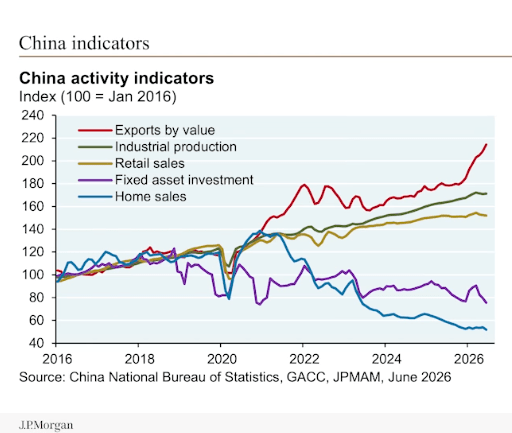
export is the bright spot
higher energy self-sufficience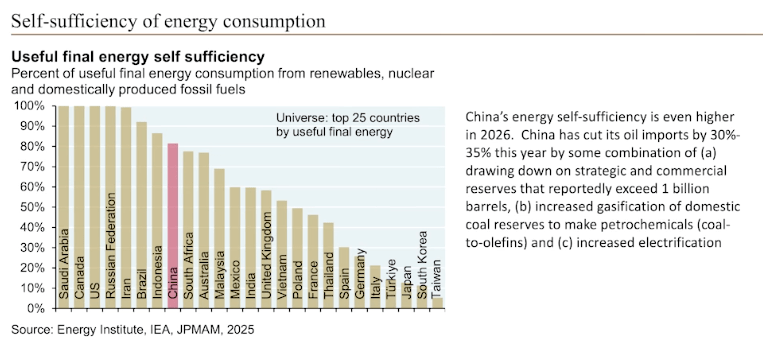
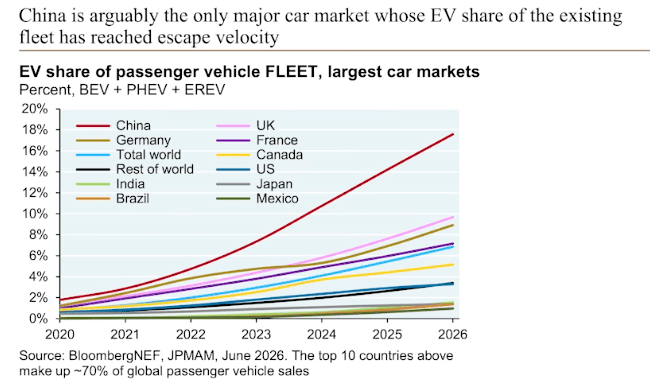
EV as % of fleet (not new car sales)
Companies operating at a loss
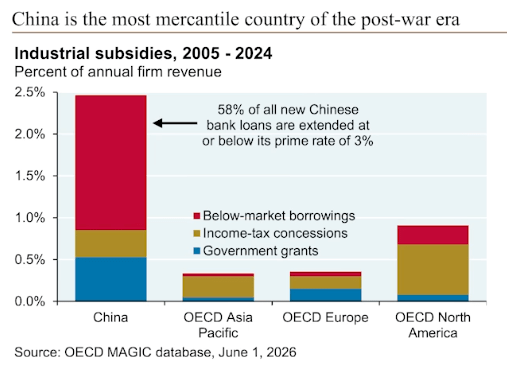
besides all sorts of subsidies, low borrowing rate is a root cause (with a high savings rate)
Where is our thought leader these days?
Moreover, if we move in the direction of making machines which learn and whose behavior is modified by experience, we must face the fact that every degree of independence we give the machine is a degree of possible defiance of our wishes. The genie in the bottle will not willingly go back in the bottle, nor have we any reason to expect them to be well disposed to us.
Wiener_Norbert_The_Machine_Age_v3_1949
Meanwhile,
I think affluent middle class is key to a lot of things, especially for the US.
The rise of cheap Chinese open-weight models is a shock, if not an “attack”.
“Middle class” that is merely existing without a lot of options in life is not affluent middle class. Free will doesn’t prevail in this case.
1/ OpenAI warrants and target price
OpenAI’s AMD warrant (max 160 million AMD shares) agreement says the first tranche follows delivery of the first 1 GW and full vesting requires purchases reaching 6 GW. AMD also disclosed that the stock-price targets rise to $600 for the final tranche.
AMD last year talked about $20 non-gaap EPS within the next three to five years. And now it says it will be significantly above $20.
Using the Nov 2025 stated goal of $20, OpenAI’s last tranche of $600 is 30x, and given it maybe $30 non-gaap eps, it’s just 20x.
2/ Lisa Su doesn’t own much?
Lisa Su currently owns approximately 3.61 million AMD shares outright, equal to about 0.22% of AMD.
AMD’s March 2026 proxy disclosed that Su also held 413,529 options exercisable within 60 days. Adding those to her currently reported actual shares gives approximately 4 milion beneficially owned shares or approximately 0.247% of AMD.
However, she came as CEO. She is not the founder.
Who is the first the blink?

Looks like Meta?
Sure Meta can / will need to sell more compute, which then supports more capex.
But that is an entirely new business for Meta.
Changxin Technology Group got listed on Monday.
It’s such a big event – it becomes mainland China’s most valuable listed company.
Here is a list of 合肥市委书记 (Hefei Party secretaries) in those years.
Taking 2016, when CXMT was established in Hefei, as the starting point, five Hefei Party secretaries are relevant to the company’s development:
| Hefei Party Secretary | Term | CXMT Development Stage | Subsequent Career and Current Status |
|---|---|---|---|
| Wu Cunrong (吴存荣) | Sep. 2011–Nov. 2016 | Project incubation and establishment | Later served as Executive Vice Governor of Anhui, Executive Vice Mayor and Deputy Party Secretary of Chongqing, Vice Chairman of the Chongqing People’s Congress, and Chairman of the Shanxi CPPCC. Investigated in December 2024 and sentenced at first instance in March 2026 to life imprisonment for accepting more than RMB 127 million in bribes. |
| Song Guoquan (宋国权) | Nov. 2016–May 2020 | Fab construction, technology introduction, and initial mass production | Later became Vice Chairman of the Anhui Provincial People’s Congress. Retired after the 2023 leadership transition and now mainly serves as President of the Anhui Intangible Cultural Heritage Research Association. He continues to appear at public events. |
| Yu Aihua (虞爱华) | May 2020–Mar. 2024 | Capacity expansion and development of the surrounding semiconductor ecosystem | Subsequently promoted to Deputy Party Secretary of Anhui and Secretary of the provincial Political and Legal Affairs Commission. In 2025, he moved to the Anhui CPPCC as Deputy Party Secretary and Vice Chairman. He continues to perform public duties. |
| Zhang Hongwen (张红文) | Mar. 2024–Mar. 2025 | Mature expansion and IPO preparation | Disappeared from public view after December 2024, left his positions without receiving a new appointment, and was later removed as an Anhui Provincial People’s Congress delegate. His status is highly unusual, although no formal disciplinary investigation has been publicly announced. |
| Fei Gaoyun (费高云) | Apr. 2025–May 2026 | Final IPO preparation stage | Placed under disciplinary and supervisory investigation on May 6, 2026. As of the latest public information, no subsequent announcement of expulsion from the Party, prosecution, or sentencing had been made. |
CXMT and the first phase of its Hefei DRAM manufacturing project were established in 2016. Wu Cunrong (吴存荣) remained Hefei Party secretary until November of that year, meaning the project’s initial planning, government investment framework, and decision to locate in Hefei were likely developed during the final period of his tenure.
However, the construction of the fabs and the transition into commercial production mainly occurred under his successor, Song Guoquan (宋国权).
After leaving Hefei, Wu Cunrong (吴存荣) continued to rise through the political system and eventually became Chairman of the Shanxi CPPCC. A court later found that he had accepted more than RMB 127 million in bribes between 2006 and 2024 while holding various government positions, including those of Hefei mayor and Hefei Party secretary.
Public court documents have not specifically linked his bribery case to CXMT. It would therefore be inappropriate to claim that his criminal case involved the CXMT project.
Assessment: Wu Cunrong (吴存荣) was the Party secretary during CXMT’s project-establishment phase, but not the principal official responsible for its construction and commercialization.
Song Guoquan’s (宋国权) tenure covered CXMT’s most difficult transition: moving from plans and capital commitments to a functioning fab and commercially viable DRAM production.
Key milestones during his tenure included:
Among the five officials, Song Guoquan (宋国权) therefore had the most direct association with CXMT’s successful execution. During his tenure, the company had already committed substantial capital but had not yet proven its technology or manufacturing capability. The core task was to complete the facility, establish a production process, achieve acceptable yields, and begin commercial shipments.
After leaving the Hefei Party secretary position, Song Guoquan (宋国权) became Vice Chairman of the Anhui Provincial People’s Congress. He subsequently retired from full-time government office and has remained publicly active through cultural and intangible-heritage organizations. There have been no public reports of investigations or disciplinary action against him.
Assessment: Song Guoquan (宋国权) was CXMT’s “construction and mass-production Party secretary.” His tenure was the most important for turning the company from a government-backed project into an operating DRAM manufacturer.
Yu Aihua (虞爱华) took office in May 2020, after CXMT had already achieved initial DDR4 mass production. The company’s strategic focus had therefore shifted from proving the viability of one fab to expanding capacity, upgrading technology, and developing a broader local semiconductor supply chain.
During his tenure:
Yu Aihua (虞爱华) frequently described Hefei’s model as “industrial investment” rather than ordinary venture capital. Under this approach, the local government combined equity investment, land, infrastructure, financing, supply-chain development, and customer-market support to build strategic industries.
In 2024, Yu Aihua (虞爱华) was promoted to Deputy Party Secretary of Anhui and also served as Secretary of the provincial Political and Legal Affairs Commission. In 2025, he moved to the Anhui CPPCC as Deputy Party Secretary and Vice Chairman.
This represented a clear reduction in executive authority and effectively ended his upward political trajectory. However, he has continued to participate in public meetings and official activities, and there has been no public indication that he is under investigation.
Assessment: Yu Aihua (虞爱华) was CXMT’s “capacity-expansion and industrial-ecosystem Party secretary.” He helped develop CXMT from a standalone manufacturing project into the center of a larger Hefei semiconductor cluster.
Zhang Hongwen (张红文) became Hefei Party secretary in March 2024 and remained in the position for roughly one year.
By this point, CXMT was already an established DRAM producer. Zhang Hongwen’s (张红文) tenure therefore corresponded more closely to advanced-product expansion, corporate restructuring, financing, and preparation for a potential public listing than to the company’s original establishment or manufacturing ramp.
His departure was highly unusual:
This combination of events commonly suggests serious internal disciplinary action, organizational investigation, or another form of political handling. However, no formal announcement by the Central Commission for Discipline Inspection has publicly confirmed that Zhang Hongwen (张红文) is under investigation.
There is also no authoritative public evidence linking his disappearance or removal to CXMT.
Assessment: Zhang Hongwen (张红文) was CXMT’s “mature expansion and capital-markets preparation Party secretary.” He appears likely to have encountered serious political trouble, but the specific cause remains undisclosed.
Fei Gaoyun (费高云) became Hefei Party secretary in April 2025 and served for approximately one year.
His tenure covered the final stages of CXMT’s listing preparation and continued capacity expansion. On May 6, 2026, the Central Commission for Discipline Inspection announced that Fei Gaoyun (费高云) was under investigation for suspected serious violations of discipline and law.
CXMT subsequently completed its public listing in July 2026, meaning Fei Gaoyun (费高云) was investigated before the company formally entered the public market.
As of the latest information included in the original summary, there had been no public announcement that Fei Gaoyun (费高云) had been expelled from the Party, transferred for prosecution, or sentenced. The investigation remained ongoing.
There is no authoritative evidence that his case is connected to CXMT.
Assessment: Fei Gaoyun (费高云) was CXMT’s “IPO preparation Party secretary.” His long-term contribution to the company is difficult to evaluate because his tenure was brief and ended with a formal investigation.
The political outcomes of the five Hefei Party secretaries associated with CXMT’s development have varied substantially:
In terms of their direct importance to CXMT’s development, a reasonable ranking would be:
Song Guoquan (宋国权) > Yu Aihua (虞爱华) > Wu Cunrong (吴存荣) > Zhang Hongwen (张红文) ≈ Fei Gaoyun (费高云)
Song Guoquan (宋国权) ranks first because his tenure covered construction, technology validation, and the beginning of commercial production. Yu Aihua (虞爱华) ranks second because his tenure covered large-scale expansion and the development of Hefei’s broader semiconductor ecosystem. Wu Cunrong (吴存荣) was relevant to the project’s initial formation, while Zhang Hongwen (张红文) and Fei Gaoyun (费高云) served during later, relatively short periods.
It is important not to infer that CXMT itself was involved in corruption merely because several former Hefei Party secretaries later encountered political or legal problems. Public information concerning Wu Cunrong (吴存荣), Zhang Hongwen (张红文), and Fei Gaoyun (费高云) has not established a direct connection between their cases and CXMT.
CXMT’s development was the result of several factors working together over multiple political administrations: local-government industrial investment, national semiconductor policy, the work of the company’s management and engineering teams, and sustained access to capital and manufacturing resources.
Here is the list of relevant Hefei mayor
| Hefei mayor | Term | CXMT stage | Subsequent career and current status |
|---|---|---|---|
| Zhang Qingjun (张庆军) | Jan. 2012–Aug. 2016 | Project incubation and initial approval | Investigated in July 2016 and expelled from the Party and public office in December 2016. I found no authoritative public announcement of a subsequent prosecution or sentence. |
| Ling Yun (凌云) | Aug. 2016–Apr. 2021 | Fab construction, technology validation and first commercial production | Became Huangshan Party secretary in 2021. Since January 2025, she has served as director of the Anhui CPPCC Hong Kong, Macao, Taiwan, Overseas Chinese and Foreign Affairs Committee. |
| Luo Yunfeng (罗云峰) | Apr. 2021–Jan. 2026 | Capacity expansion, product upgrading and IPO preparation | Resigned as mayor in January 2026 and became Party-group secretary of the Anhui CPPCC Economic Committee. This appears to be a normal retirement-transition appointment. |
| Zhang Quan (张泉) | Jan. 2026–present | IPO completion and post-listing expansion | Current Hefei mayor. He had already served as Hefei executive vice mayor from 2023, so his involvement with CXMT began before becoming mayor. |
Summartized and written by ChatGPT.