~$40bn Apollo acquisition – GE Capital Aviation Services (GECAS), GE’s aircraft leasing operations
Bidder: Apollo, an offer as much as $40 billion according to Bloomberg & Reuters
GECAS has a fleet of more than 1,900 planes, which it provides to airlines under long-term leases.
1/4/2019
~$1bn KKR investment – Altavair, focusing on the acquisition of new and used commercial aircraft for leasing to passenger airlines and cargo operators
Investor: KKR, $1 billion capital commitment to acquire commercial aircraft in partnership with Altavair + a 50% interest in Altavair; Altavair will be KKR’s partner for aircraft leasing investments going forward
Since its inception in 2003, Altavair has completed over $8 billion in commercial aircraft lease transactions with over 40 airline customers in 27 countries representing over 200 individual Boeing and Airbus aircraft
~$5bn Carlyle acquisition – StandardAero, largest independent maintenance, repair and overhaul (MRO) providers
Bidder: Carlyle, for more than $5 billion (Reuters) from Veritas
Veritas acquired StandardAero from Dubai Aerospace Enterprise Ltd (DAE) for $2.1 billion, including debt, in 2015
Carlyle first acquired StandardAero in 2004. In 2007, DAE simultaneously purchased StandardAero and Landmark Aviation, also an aircraft maintenance services company, from Carlyle in a transaction valued at $1.8 billion, including debt.
~$15bn Apollo acquisition – Arconic (ARNC), aluminum products used around the world by aerospace manufacturers
Bidder 1: Blackstone, Carlyle, Onex and Canada Pension Plan Investment Board
(winning) Bidder 2: Apollo, seems winning with a potential acquisition price of $22; also considered is a spin-off of its cladding operation with potential liability from the Grenfell Tower fire of two years ago.
In the fourth quarter specifically, the S&P 500 and Nasdaq plunged 13.97 percent and 17.5 percent, respectively, their worst quarterly performances since the fourth quarter of 2008. The Dow notched its worst period since the first quarter of 2009, falling nearly 12 percent. (CNBC)
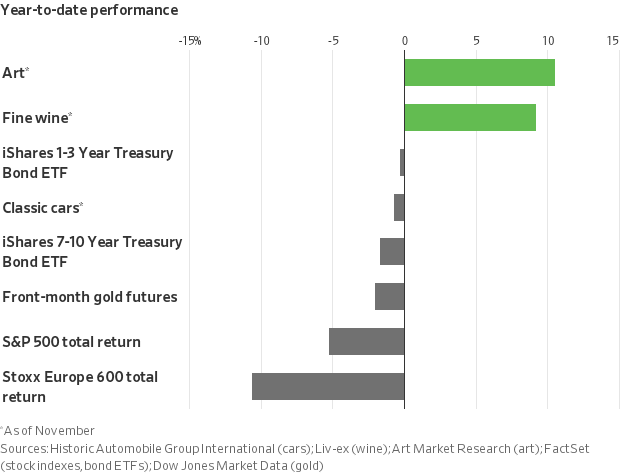
Meanwhile, assets like fine wine and art are gaining
Liv-ex Fine Wine 1000 index – 2018 | Source: liv-ex.com
According to The Liv-ex Fine Wine 1000 index, which tracks 1,000 wines from across the world, the price has been on a steady rise since May 2016.
People who put money into art at the beginning of the year saw an average gain of 10.6% by the end of November, according to Art Market Research’s Art 100 Index. (WSJ)
And in December’s Art Basel in Miami Beach, one of the world’s preeminent art fairs, things seemed going smooth. In a detailed report, owners of Mark Rothko’sUntitled (Yellow, Orange, Yellow, Light Orange) (1955), a painting purchased at Sotheby’s in 2014 for $36.6 million, was asking $50 million for the painting and said was on reserve later on. “The price tag is high even for the elite Art Basel franchise of fairs.”
In a summary…
Luxury Goods Outperform as Markets Swoon | Source: WSJ
Talks around Canada’s housing market have been surging – about its booming prices and about its looming risks.
The price side – directly shown by its pricing index from Statistics Canada – plotted below from Jan. 2006 – Oct. 2018.
Canada Housing Price Index | Source: Author, Statistics Canada
Toronto’ prices are the most wild in among Canada’s housing markets – nearly doubled in 39 month from Jan. 2014 to Apr. 2017.
Toronto home prices 2014 – 2017 | Source: Financial Post
The price itself is not actually something to worry about. But as FT argued, “House prices have raced ahead of wages for years, boosted by loose lending, low interest rates and lax controls on foreign money.” Similarly on Huffpost, “Toronto’s house price index doubled between 2011 and 2017, even as household incomes grew by single percentage points.”
And let’s take a look at the housing debt level – the risky side.
Bank of Canada said the two trillion dollars of debt is around 170% of disposable income.
and housing debt versus GDP – just passed 100% for 2017 Q2.
The regulator took actions to cool down the market.
The short-sellers/investors took theirs too.
Home Capital is at the center, Canada’s largest provider of home loans to the newly arrived and self-employed.
Home Capital Stock Price (C$) | Source: Bloomberg
In Jun. 2017, Warren Buffett’s investment vehicle Berkshire committed to acquire a 38.39% stake as part of a rescue package (C$2.4 billion, including C$400 million equity and C$2 billion credit line with 9% interest rate). The first tranche of equity investment acquired a 19.99% ownership.
However as the second tranche of equity investment wan’t approved, now in Dec. 2018, the updates came as Buffett would sell most of its stake and reduce ownership level to less than 10%.
Home Capital is under control and stabilized now.
A single crisis is easier to solve than a systematic problem between housing prices and local income.
Robinhood recently prepared to launch its stunning checking & saving offering for cash management with a 3% rate.
That is an astonishing number compared with regular checking accounts (and saving accounts). Industry average is 0.08 percent yield on U.S. checking accounts and the 0.1 percent average on savings accounts (find more about rates here on bankrate.com).
Comparison provided by Robinhood | Source: checking.robinhood.com cached by Google
However, the comparison didn’t last long… as Robinhood pulled back and slowed down it official launch. The center question is that “accounts look like bank accounts, (but) they aren’t.” Below is the description at the bottom of the website.
Robinhood Financial LLC and Robinhood Crypto, LLC are wholly-owned subsidiaries of Robinhood Markets, Inc. Equities and options are offered to self-directed customers by Robinhood Financial. Robinhood Financial is a member of the Financial Industry Regulatory Authority (FINRA) and the Securities Investor Protection Corporation (SIPC), which protects securities customers of its members up to $500,000 (including $250,000 for claims for cash). Explanatory brochure available upon request or at www.sipc.org. Cryptocurrency trading is offered through an account with Robinhood Crypto. Robinhood Crypto is not a member of FINRA or SIPC. Cryptocurrencies are not stocks and your cryptocurrency investments are not protected by either FDIC or SIPC insurance
It is not FDIC protected and it is reported that – “the head of the Securities Investor Protection Corp. (SIPC) told CNBC on Friday that the start-up didn’t contact his office ahead of the product launch, and to his knowledge Robinhood had not contacted the SEC, either.”
While regulation is an issue, another question is – whether 3% reasonable / doable?
Historical CD Interest Rates – 1984-2016 | Source: bankrate.com
US has been through years of low-interest environment; people are not familiar with 10% or 5% interest rate back then. But after Fed’s meeting this week, it is highly likely that there is another 25bp raise, pushing fed funds rate into a range of 2.25 to 2.50 percent.
I should say 3% in 2019 is not undoable. But the core difference is a marketing issue. Robinhood could invest in higher yield products.
But in consumers’ view, it is truly disrupting and may level up the playground for all players in this field.
The time of easy money is gone. The startups or new initiatives with better and sustainable solutions (usually tech-oriented) are attacking the incumbents. Robinhood may or may not be the one (and this may not be the exact right approach), but the industry needs to be prepared.
Democratic – there is no limit to how much they can take from government
Republican – there is no limit to how little they can give to government
where “they = voters”
It seems that the swing between two parties causes the constantly larger promises that are asymmetric in terms of what voters get – no one would promise more restrictive policies to gain votes.
Ohio is becoming the first state to accept crypto as tax payments on https://ohiocrypto.com/.
The move is made by Ohio State Treasurer Josh Mandel. Born in Sep. 1977, he had made several moves after being elected as Ohio State Treasurer in Dec. 2010, including OhioCheckbook.com that posts all state spending information on the internet for better government transparency.
The current cryptocurrency accepted is Bitcoin, with more to come. A third party cryptocurrency payment processor, BitPay, will serve between taxpayers and Ohio State Treasury, so that the former will pay crypto and the latter will receive dollar.
Although the State Treasurer himself is said to be an enthusiast of cryptocurrencies and blockchain, it might as well be seen as a state-level move to differentiate itself and embrace the future tech world. According to TechCrunch, Ohio has other moves to become tech-friendly including a technology hub forming in Columbus, home to one of the largest venture capital funds in the Midwest, Drive Capital. And Cleveland (the city once called “the mistake on the lake”) is trying to remake itself in cryptocurrency’s image with a new drive to rebrand the city as “Blockland”, etc. Columbus also reported last year that its Smart Columbus program had an expanded $417 million in resources to turn Columbus into the testing ground for intelligent-transportation systems.
Politics and future development is more interconnected than ever. Policy makers are becoming smarter and seeing/learning the tech future as others. “Policy infrastructure” played an important role in the past and will continue to do so. Each city/state may have a specialization and leveraging its hub effect. Blockchain is one of those “specializations” that many are going after. China and US are no different in terms of this strategy of development.