Revenue per GW for traditional internet/hyperscaler companies vs leading AI labs


Company Period Revenue Electricity consumed Avg. GW consumed Revenue / avg. GW
Google / Alphabet CY2025 $402.8bn ~44 TWh ~5.0 GW ~$80bn/GW
Microsoft FY2025 $281.7bn 37.03 TWh 4.23 GW ~$66.7bn/GW
Meta CY2024 $164.5bn 18.42 TWh 2.10 GW ~$78.2bn/GW

Meta’s ESG report for 2025 hasn’t released yet.

Source: ChatGPT and companies’ ESG reports

This compares to OpenAI and Anthropics $10bn/GW to $30bn/GW.


Latest annualized revenue Current/live compute ARR per GW
Anthropic ~$65bn ~2–3 GW est. ~$22–33bn/GW
OpenAI ~$40bn ~3–4 GW est. ~$10–13bn/GW


ROIC of Nvidia data center built in 2024 for 2026 inference

Assume you invested in 2024 for Nvidia chips based data centers.

Back then, you used H200.

An 8-GPU HGX H200 server is closer to roughly 10–12kW at the server level.

1 MW IT load → ~80–90 eight-GPU servers
× 8 GPUs/server → ~640–720 H200s/MW
1 GW → ~640k–720k H200s

So 680 H200 per MW is probably more reasonable and thus cost ~$35mn per 1MW, or $35bn per GW.


1 GW IT load 2024 H200-era capex
GPU/HGX servers ~$18–24bn
Networking/storage ~$3–5bn
Facility/power/cooling ~$8–12bn
All-in ~$30–38bn/GW

Source: ChatGPT

How much revenue it can generate today?

Using DeepSeek V4-Pro pricing and token per day estimates like this give you ~$33.3k revenue/day/MW, or ~$12.2bn revenue/year/GW.


Per MW/day Tokens
Input ~51.0bn
Output ~12.8bn
Total ~63.8bn

Source: ChatGPT

Assume cash ebitda margin is 80%.

So the 2024 H200 gives you $10bn per year.

After tax (depreciation deducts income), that is ~30% roic over the $35bn capex in 2024.

Best AI

The best AI is the AI that can learn the best after being created.

Education is college is pre-training.

Humans with the best grades in college is probably not the best humans afterwards.

Even you add post-training, which is like internship or few years of work experience, that is still not the best part.

The best AI/human can keep compound on itself.

That is especially true for AI as it can live much longer.

Alibaba’s 3-year payback period

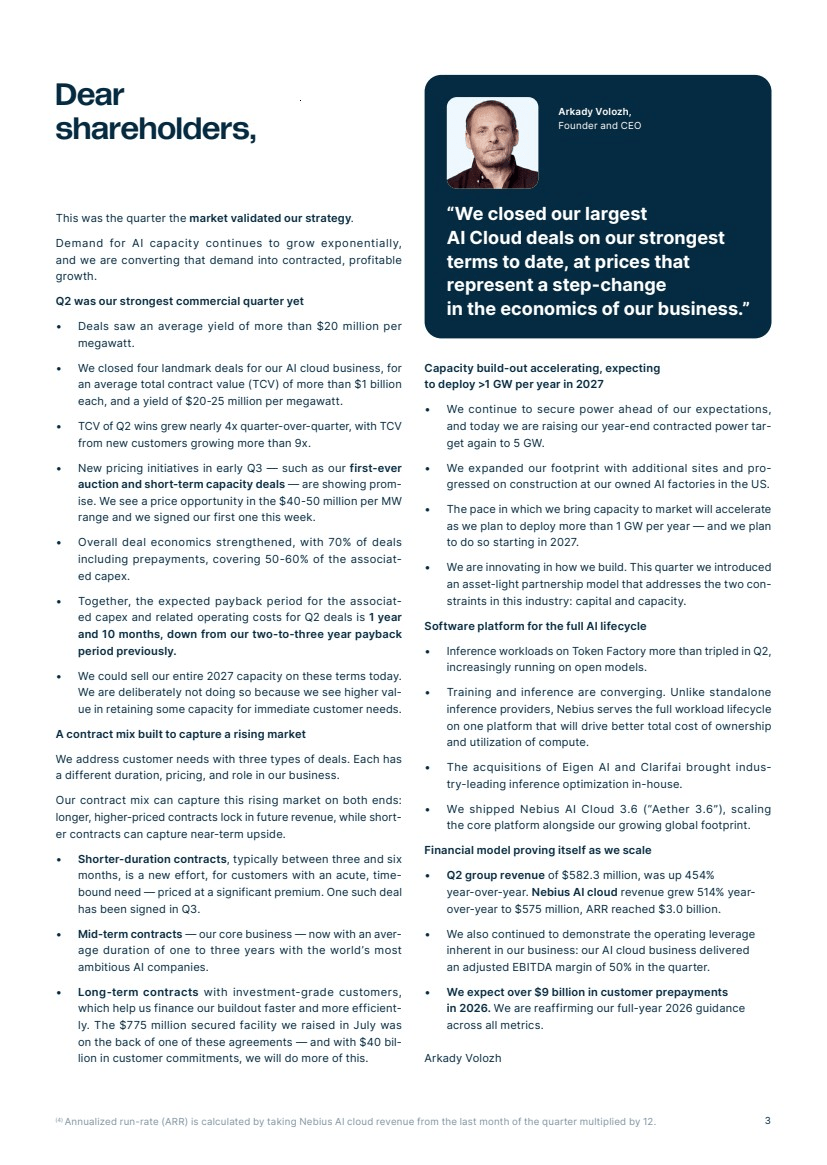
In Alibaba’s earnings call, it touted 3 years of payback and could improve that to 2.5 years or even 2 years.

That sounds strong.. but if you compare, that is nothing.

Even Luckin claims its franchisees have 1.5 – 2 years of payback periods.

And SpaceX said during recent 2q26 earnings that it has <1 year of payback period.

Nebius’s payback period is now 1 year and 10 months, down from 2-3 years, disclosed in 2q26 earnings.


Diverging path: Baidu vs. Google

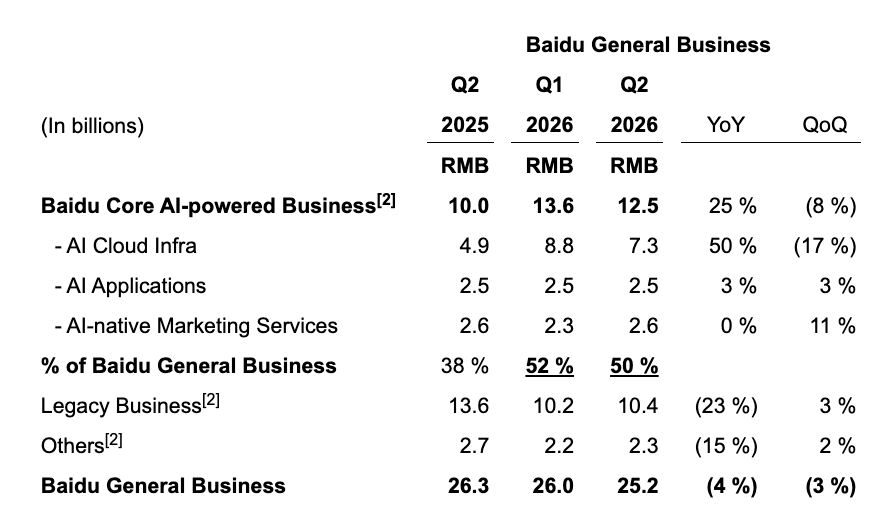
In Q2 2026, Baidu online marketing revenue fell 19% YoY to RMB13.1bn, after falling 22% in Q1.

And AI-native ads doesn’t seem impressive.

Meanwhile Google Search & Other revenue grew 17% YoY to $63.3bn in 2q26.

Google search revenue didn’t feel much impact from growing usage of chat AI.

One difference, probably unrelated to AI-era, is that content sits inside giant closed ecosystems, much of which Baidu either can’t index properly or isn’t the natural starting point for.

Consumers can go directly to vertical apps. This is especially true when mobile is more important than web in China.

Baidu is simply not the end of a discovery journal, while Google still is.

Even if you chat with AI, you might still go to Google to do final checks or to look for places to do the transaction.

Another issue is that Google AI Overview seems more successful in monetization.

Baidu management says it is “deliberately holding back” AI-search monetization.

Google previously disclosed that queries showing AI Overviews monetized at approximately the same rate as traditional Search, and in Q2’26 said it continued to be encouraged by AI Overview monetization even as it expanded into more commercial queries.
 

Nvidia is the central bank

Token is an asset.

Your account has a number – the number of tokens you can use.

Those tokens can be used to do anything. You either get what you want from tokens, or you make something out of tokens and sell / exchange it for other stuff.

It’s an asset that is so versatile that is like “money”.

In accounting, money is an asset.

In economy, money is the medium of exchange.

Tokens are like money in those regards.

Token factories are like banks.

The factory prints tokens with electricity.

Nvidia’s servers, at the frontier, determines the speed of inflation.

If Nvidia’s next gen servers are too good and sells cheap, token can be printed fast! Thus the token on hand can be depreciated.

In that sense, Nvdia is like Fed that controls inflation.

Thoughts from people more than 75 year ago

Where is our thought leader these days?

Moreover, if we move in the direction of making machines which learn and whose behavior is modified by experience, we must face the fact that every degree of independence we give the machine is a degree of possible defiance of our wishes. The genie in the bottle will not willingly go back in the bottle, nor have we any reason to expect them to be well disposed to us.

Wiener_Norbert_The_Machine_Age_v3_1949

Meanwhile,

I think affluent middle class is key to a lot of things, especially for the US.

The rise of cheap Chinese open-weight models is a shock, if not an “attack”.

“Middle class” that is merely existing without a lot of options in life is not affluent middle class. Free will doesn’t prevail in this case.

About AMD

1/ OpenAI warrants and target price

OpenAI’s AMD warrant (max 160 million AMD shares) agreement says the first tranche follows delivery of the first 1 GW and full vesting requires purchases reaching 6 GW. AMD also disclosed that the stock-price targets rise to $600 for the final tranche.

AMD last year talked about $20 non-gaap EPS within the next three to five years. And now it says it will be significantly above $20.

Using the Nov 2025 stated goal of $20, OpenAI’s last tranche of $600 is 30x, and given it maybe $30 non-gaap eps, it’s just 20x.

2/ Lisa Su doesn’t own much?

Lisa Su currently owns approximately 3.61 million AMD shares outright, equal to about 0.22% of AMD.

AMD’s March 2026 proxy disclosed that Su also held 413,529 options exercisable within 60 days. Adding those to her currently reported actual shares gives approximately 4 milion beneficially owned shares or approximately 0.247% of AMD.

However, she came as CEO. She is not the founder.

From capex to backlog

For the past few quarter, capex figures and related comments from hyperscalers are the key metrics to watch, especially for gauging future demand for semiconductor companies.

The higher the capex number, the higher the revenue estimates.

This worked but became less useful lately.

Investors don’t like it if only the capex is growing, which pushes hyperscalers free cash flows to negative territory.

Investors want to see higher demand signal, which can justify these higher capex numbers.

Thus, backlogs or RPOs (emaining performance obligations) are more important now.


Quarter AWS backlog Microsoft commercial RPO Google Cloud backlog Oracle total RPO
1Q25 189 315 90 130
2Q25 195 368 106 138
3Q25 200 392 155 455
4Q25 244 625 240 523
1Q26 364 627 462 553
2Q26 496 678 514 638

Another thing to watch is the weighted-average backlog duration of these backlogs – within how many years will backlog become revenue?

Microsoft explicitly commented about 2.3 years.

RPO, including OpenAI, has a weighted average duration of 2.3 years. And roughly 30% will be recognized in revenue in the next 12 months, up 37% year-over-year. The remaining portion recognized beyond the next 12 months increased 112%.

MSFT FY4q26 earnings call

In addition, utilization is also an indicator.

Amazon said “lion’s share” of AWS compute capacity for 2027 had ⁠already been reserved during 2q26 earning call, which is very good to hear.