|
Property bust |
Policy/short rate response |
Mortgage rate |
| US |
2006–09 |
Fed funds cut to 0–0.25% Dec. 2008 |
No major reduction during crisis, but later declined to 3–4% |
| Japan |
1990s |
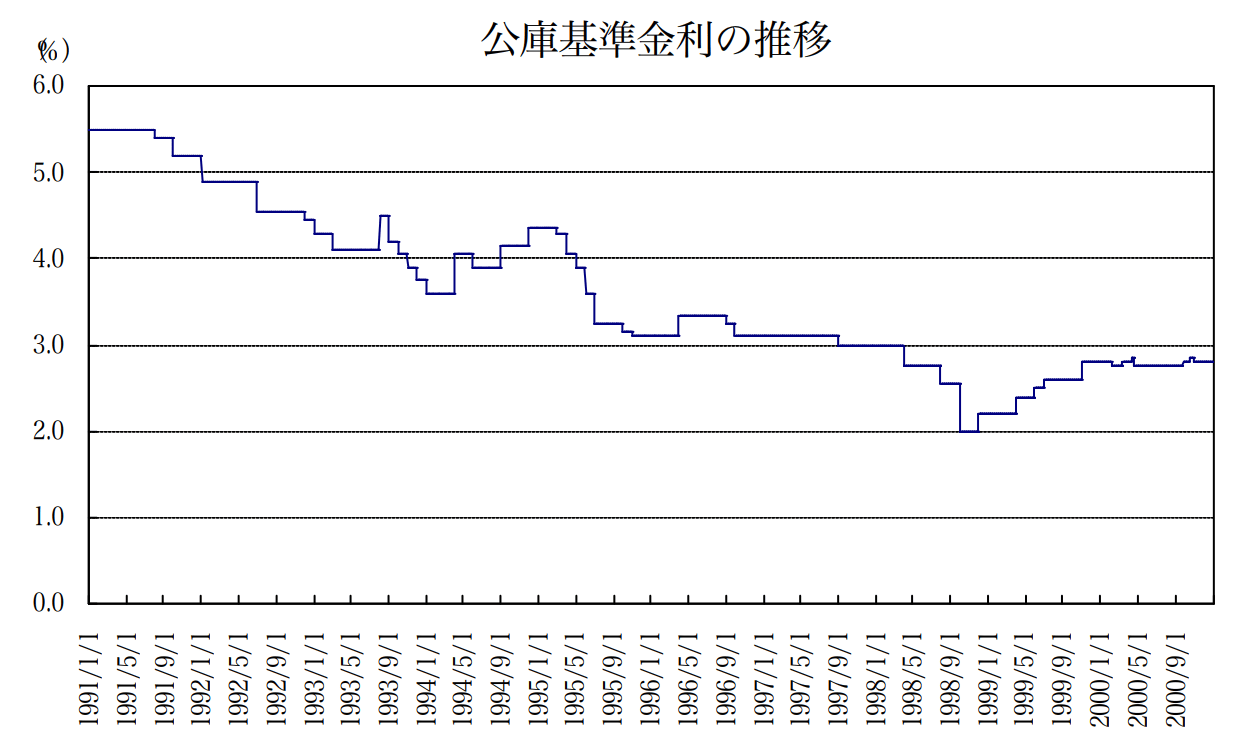
BOJ adopted near zero policy rate in Feb. 1999 |
Government housing loans reached 2% in late 1998 |
| Hong Kong |
1997–2003 |
Initially rates went UP, not down, because of HKD peg pressure; reached |
Different subsidized schemes; can be 0% up to certain point for first home buyers |
Japan
Japan’s property bubble peaked around 1990–91, but the BOJ took a long time to reach zero.
In the four years between 1991 and 1995, the official discount rate was cut from 6 percent to 0.5 percent. Before 1994 financial-market deregulation, the discount rate was the principal policy instrument. Deposit and lending rates were administratively linked to it.
On February 12, 1999, the BOJ changed its operating guideline to push the uncollateralized overnight call rate “as low as possible.” It said it would initially aim for around 0.15%, then induce a further decline.
By May 1999, the actual overnight call rate was about 0.03%, which the BOJ itself described as “virtually zero percent” after taking brokerage fees into account.
Meanwhile, the mortgage rate was cut continuously to 2% in last 1998 and kept under 3% for a long time.

US
US housing peaked around mid 2006 (Case-Shiller National Index peaked in July 2006). Total housing starts peaked earlier in January 2006 at 2.273 million, and February 2006 was the first down month at 2.119 million. The financial system is still functioning normally; Fed funds remains 5.25%.
On April 2, 2007, New Century files bankruptcy – subprime origination itself is breaking. Soon afterward, mortgage securities suffer widespread downgrades and nonprime mortgage funding dries up.
During June–July 2007, Bear Stearns hedge funds collapsed. Mortgage losses are visibly migrating from homeowners/lenders into structured-credit investors.
On September 18, 2007, Fed starts cutting rates by 50bps, from 5.25% to 4.75%.
Fed also did 50 bps cut in Dec 2007, 75 bps emergence cut in Jan 2008, another 50 bps before end of Jan 2008, 75 bps cut in Mar 2008 (as Bear Stearns itself went into trouble and merged into JP Morgan), 25 bps cut in Apr 2008. At that point, Fed fund rate target became 2%.
On December 16, 2008, Fed reached Fed reaches effective ZLB by targeting 0-0.25%.
It took 2.5 years from the peak of housing price.
On the mortgage rate side, in 2008 during the acute Lehman/AIG crisis, mortgage rates were still roughly 6–6.5%.
However, that collapsed to 3.3% in 2012.
HK
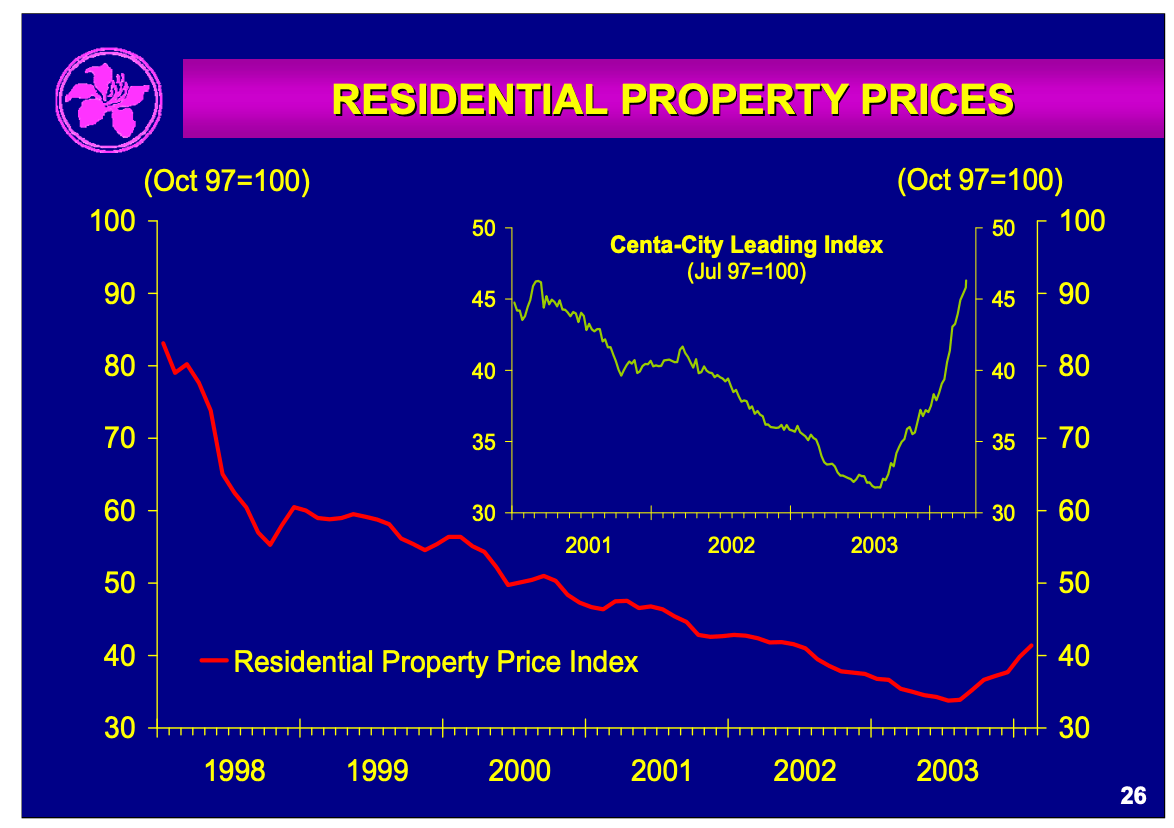
From October 1997 to July 2003, property prices fell by 66%.

Source: link
| Event |
Date |
Property price |
| Bubble peak |
Oct. 1997 |
R&VD residential index = 172.9 (1999=100) |
| Asian crisis / HKD attack |
Oct. 1997 |
Rates spike; property selloff begins |
| 1998 |
— |
Very sharp first leg down |
| 1999–2002 |
— |
Continued deflation / recessionary adjustment |
| SARS |
Mar–Jun 2003 |
Final leg of weakness |
| Bottom |
July 2003 |
~66% below Oct-1997 peak |
| Recovery begins |
H2 2003 |
Prices rebound rapidly |
Hong Kong was a different story as it’s interest rate is not independent, so it doesn’t have as much flexibility to cut rates.
But HK did have other programs to support homebuyers to essentially subsidize mortgages.
| Scheme |
Started |
Who it targeted |
Form of subsidy |
| Home Purchase Loan Scheme (HPLS) |
1988, expanded sharply in 1998 |
PRH tenants / lower-middle-income households |
0% interest government loan, or non-repayable monthly mortgage subsidy |
| Home Starter Loan Scheme (HSLS) |
Apr 1998 |
First-time middle/lower-income buyers |
Low-interest government down-payment loan, up to HK$600k / 30% of property |
| Mortgage Subsidy Scheme (MSS) |
Sep 1998 |
Certain redevelopment/clearance households buying HOS/PSPS |
Mortgage subsidy up to HK$162k over 6 years |
| Buy or Rent Option (BRO) |
Jul 1999 |
Eligible PRH applicants choosing ownership instead |
Mortgage subsidy up to HK$162k over 6 years |
| Home Assistance Loan Scheme (HALS) |
Jan 2003 |
Replacement/consolidation scheme |
0% loan or monthly mortgage subsidy |
The Home Purchase Loan Scheme existed before the crash, from 1988, but Hong Kong massively expanded it in 1998.
It offered an interest-free government loan alongside the bank mortgage. Before the crisis:
- private-housing / White Form families: HK$400k at 0%
- public-housing / Green Form tenants: HK$600k at 0%
- repayment could extend up to 20 years
Alternatively, borrowers could choose a non-repayable monthly subsidy instead of the loan.
Then in July 1998, after property prices had collapsed, the Housing Authority increased the annual quota from 4,500 to 10,000 and added larger/flexible loan options.
By 1999–2000 the enhanced options were:
- Green Form: HK$800k at 0% over 13 years, or HK$600k over 20 years
- White Form: HK$500k at 0% over 14 years, or HK$400k over 20 years
Alternatively:
- Green Form: HK$5,100/month for 4 years
- White Form: HK$3,400/month for 4 years
and those monthly subsidies did not have to be repaid.