Tag: Tech
从高通今天 Q4 财报回看与苹果的争端
高通财报 FY Q4 收入低于预期,净利高于预期,苹果手机不采用高通芯片的影响在数字上反映得很明显,包括对于下个季度的预期(9-12月)。
回顾一下智能手机和苹果手机的近几年发展,到与高通的关系,有这么一个逻辑:
2014年开始全球智能手机增量市场感受到相当大阻力,以出货量增长放缓乃至不增长为标志。苹果依靠iphone建立起的帝国开始面临一系列问题。这在苹果公司内部或高层应该被经常讨论,也早已市场感受或预料到(比如2011/2012年)。苹果整体利润水平开始有下滑,尤其用2016&2017年比较之前。收入无非是单价*数量。数量增上不去,只能在单价上做文章,iphone的提价路线开始清晰。另一方面,高通芯片和技术授权的成本开始变得更重要。在高增长时期,大家合作共赢,有问题拖到后面再说;增长放缓,则要把分蛋糕的事情再拿出来讨论。如果高通定价为固定数额,那iphone提价是妥妥地提高苹果利润空间;但事实并非如此。高通以手机单机为基础的计价方式让苹果很头大。2015甚至更早的时候,高通苹果应该就有过相关讨论。但作为行业风向标,苹果的谈判结果势必影响高通与其它手机厂商的合同;从这点上说,高通也绝对不想让。大家都盯着这一代智能手机最后的赚头不放手。矛盾爆发在2016,苹果让生产商拒付高通部分费用。也是为2017年iphone X提价到$999做了铺垫。经过两年多准备和研究,2018年起的iphone已经不再采用高通,转用英特尔。
整个事件对与高通来说自然是不好过。苹果手机卖得最贵,贡献的收入自然多。高通不希望失去苹果这个大客户和行业巨头。但同时,高通很明确自己作为供应商的角色。想成为有话语权的供应商,一定要保证下游客户数量和平衡。苹果固然重要,但这一代智能手机的后半场苹果的声音越来越小。虽然苹果依旧可以赚很多钱,依然是最受欢迎,整体体验最好的手机;但在后半场里,印度中国等市场中购买力不出众的消费者撑起了半片天。苹果做不到的,抓不到的消费者,高通可以通过其它OEM捕捉到。另一个角度来说,苹果高通的纠纷让高通提前跳下了有点下沉的巨轮。即使再往前开,高通从苹果身上也赚不到多少。
苹果7-9月财报和未来预期已经说明了很多;不再报告iphone销量数字也成为让投资人不安的点之一。
所以,即便平行空间里高通苹果还是朋友,有一个修改过的合作,高通这季度开始之后几个财报也不会因此亮眼。
而我觉得高通 sexy 的地方还是在于 5G 和 IoT 的时代。5G 概念下包括可下一代手机,AR/VR,车联网,自动驾驶等;IoT 概念下可以算上智能家居等,越来越多设备将连上网络/云端,但不一定需要 5G。
2019将是高通的转折年。可能看不到大涨的基础;好的话应该是为下一个5年的领导地位打下基础;差的话,很多今天挂在嘴边的应用还要过数年才能实现/实用,以及新技术新标准新共识的出现。
「Video of the Week」Elon Musk 2017 – The future we’re building and boring
The future in Elon’s world – future underground and future on Mars in conversation with TED’s Head Curator, Chris Anderson.
Some screenshots:


The underground highway.

40-story tall space-vehicle, enough to take Boeing 747 as cargo.
140 -> 280: How Twitter’s Length Limit Shapes The Language Used
Social network platforms such as Twitter and Weibo, are where we post our words/expressions, and is taking an essential role in todays’ Modern Communication.
Interestingly, but not surprisingly, they are also providing a feedback loop to change our ways of communication (and our thinking – but that’s another different story). After all, we are one of those animals with natural herding inclinations.
Taking a very simple example – as Twitter was becoming more popular, people started to lean heavily towards the use of new abbreviations, partially due to its 140-word limit. (Similarly, when Blackberries were popular, certain abbreviations were created, used and spread among professionals in texts & emails)
In 2017, Twitter officially made its “140-word limit” a history [Weibo ended the limit in 2016] and doubled the character limit to 280. One resulting impact is that people are spelling out abbreviations and acronyms more often, according to Twitter’s report.
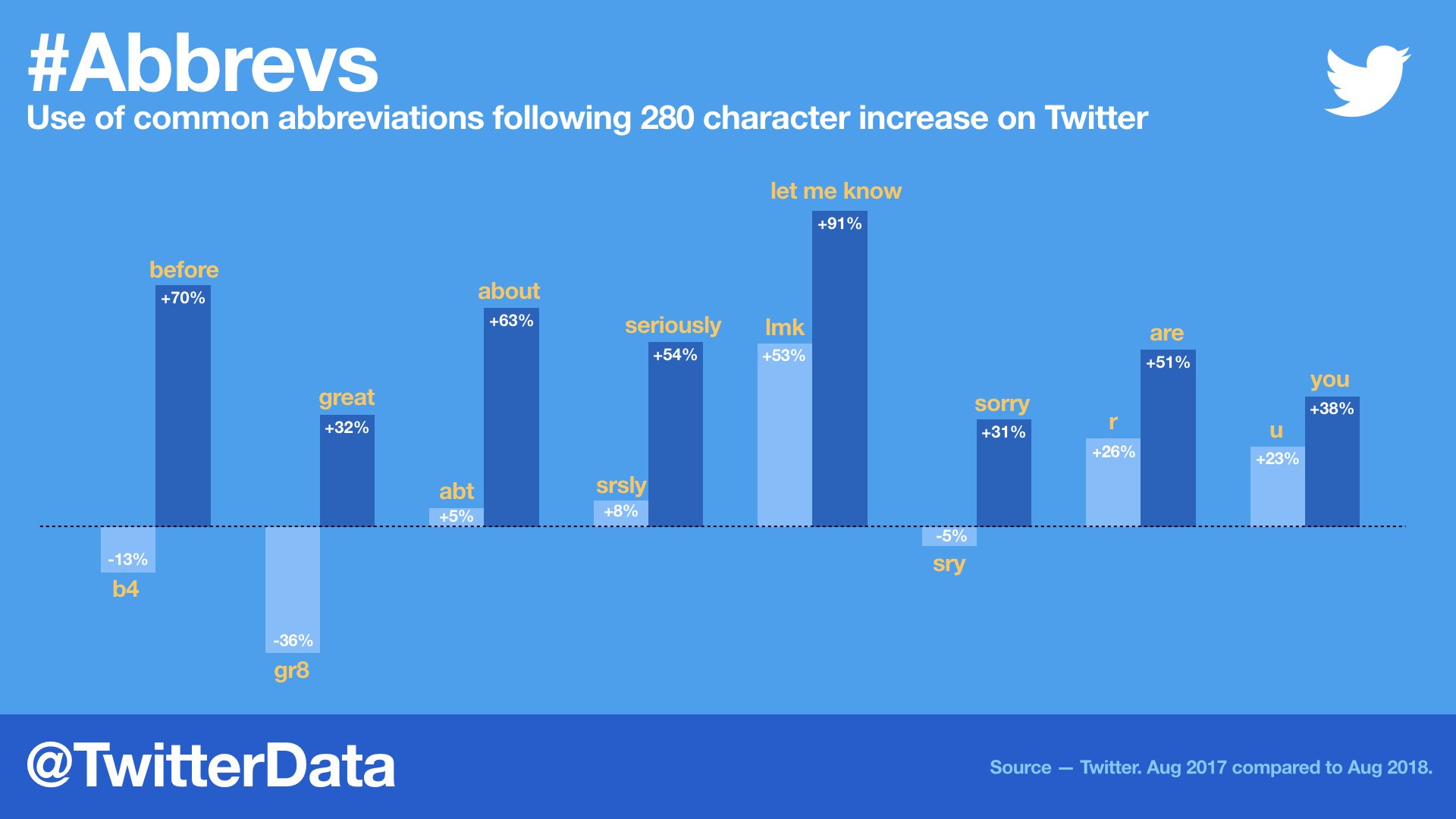
TwitterData also touted that “people are saying ‘please’ (+54%) and ‘thank you’ (+22%) more.” in the first year of doubling limit.
[Something worth noting on the data – 1) need to consider the difference in total number of tweets 2) need to consider other ways of saying ‘please’ and ‘thank you’…]
It is really nice that people could be more friendly and polite (not excessively tho). It would be even nicer if people could inherit their concise and efficient use of language in the 140-word era & all the other positive impacts Modern Communication made on us.
Apple’s Pricer New Products and 2-Way Strategy
Today Apple announced new products of three lines of business – MacBook Air, iPad Pro and Mac mini.


Besides the new features and superior performance, Apple seems to be more addicted to aggressive price tags. Today’s event is the latest episode of a series, starting from the 10-year anniversary model iPhone X last year.
[discussion below is based on the most basic consumer version of each product]
9/12/2017 – iPhone X introduced @ $999, a 30% increase from the high-end phone (iPhone 7 Plus @ $769) one year before
5/27/2018 – updated iPad introduced @ $329, flat with the new iPad debut price in Apr. 2017.
7/12/2018 – updated MacBook Pro @ $1,799; the price seems to be the same as Oct. 2016’s debut price with Touch Bar, but is a 20% increase in terms of available low-end option (MacBook Pro with no Touch Bar @ $1,499).
9/12/2018 – iPhone XR @ $749, increased by 7% ($50) compared to the low-end phone last year (iPhone 8 @$699) ; Apple Watch Series 4 @ $399, increased by 21% ($70) from a year ago @ $329.
10/30/2018 – new MacBook Air @ $1,199, a 20% increase from the old model years ago @ $999; updated iPad Pro @ $799, a 23% ($150) increase from previous Jun. 2017 version @ $649; new Mac mini @ $799, a 60% increase from the old model years ago @ $499; redesigned Apple Pencil 2 @ $129, increased by 30% from $99 when it was introduced 3 years ago
The 2-way strategy looks clear: 1. use entry-level new products (e.g. iPad & iPhone XR) to attract new users and compete with other firm’s often lower-priced products. Educational market and some international markets are important here, especially for new-user growth, ensuring an increasing number of total active users in Apple’s ecosystem and getting more market shares in terms of shipment. So there is barely any increase in price. 2. raise prices by 20-30% in other product lines to keep margin (for example Apple Watch price increase might be more associated with costs) or to compensate lower margins in entry-level products.
Apple’s overall average gross margin from 2016 to present is actually lower than the average from 2014 to 2015 (38.44% vs. 39.63%, down ~120bp), even with higher gross margins from service revenues weighing in more recently.
「新栏目」5G 股权组合 One Share of 5G Future
[NOT for recommendation purposes; more for tracking purposes]
这件事已经想了有一阵子。昨天具体构思后,简单地做一个 5G 股权指数 (index),并按着指数做这么一个组合,以 $1000/股为起始面值,以 10 月 22 日作为开始日期。
组合很简易,局限于在美股交易的股票。一开始纳入了 7 只,比重有些 arbitrary(更像是根据我现有的持有比例来的)。
这个组合的第一阶段主要是 5G 基础或者说 enabler;等 2-3 年后将调整为侧重因 5G 而爆发的应用。
成分股中分为两类 – 核心 (Core) 和 其它 (Others),将主要跟踪核心成分股,目前 4 只(高通 康宁 Verizon AT&T)。
说一下主要成分股的主要的非 5G 因素。
高通 – 主要收入继续受到智能手机出货量压力和低价压力
康宁 – 主营业务之一的显示屏单价压力,LCD 需求增长放缓,新技术的份额扩大
Verizon 和 AT&T – 传统业务,媒体业务,尤其是 AT&T 的收购和债务
英特尔 – 服务器 data center 领域要接受 AMD 的挑战,再观察一下准备移到 Core
暂时有约 20% 的现金未分配留着添加调整。
留一个截图

Glass Age 玻璃时代
玻璃在生活中随处可见,是普通到平时不会去关注的材料。
最近,在 Corning 的启发下,发现玻璃作为一个时代来说真不为过。
从一个外行浅显的角度来看,我觉得玻璃时代最重要的核心就是玻璃对于光的把握。
最明显的一个角度就是作为显示屏,手机电视平板等等。
Corning 在 iPhone 生产之初就提供了屏幕,将防 scratch 的能力提升一个台阶(Jobs 演讲前的 iPhone original 屏幕被钥匙 scratch 了,后来有了 Corning 的合作从第一代到今天)

三星的曲面屏手机也是因为 Corning 的玻璃 – 2015 年发布的 Samsung S6 Edge 开始了两边双曲面 (dual edge) 系列。

Apple Watch / Fitbit 的屏幕,日常使用比手机更容易有屏幕撞击,但 Corning 的玻璃防划一绝。


再到各类 LCD,OLED 等等显示器。未来 5G 时代的信号需要更多的玻璃参与,包括背面;未来的汽车将需要具备更多显示屏式的玻璃…


另一个角度是对于光更精确的控制。在地球上,更多玻璃自带调节功能,将在能源的转化和节约中发挥重要作用。但更具有想象力的应该是以后的外星球移居,玻璃对于模拟地球太阳光环境至关重要。
「Video of the Week」Marc Raibert of Boston Dynamics at CeBIT
Recommending this keynote from Marc Raibert – Founder and CEO of Boston Dynamics, THE most advanced creature-like robots designer (and manufacturer possibly in 2019)
Really amazing robots and
watch out for the mass production in 2019
Facebook’s Home Device with Camera and Microphone
上周 Facebook 发布了新款硬件 Portal – 一个以 FB 好友为电话簿的新型视频座机..

作为科技巨头中最后一个入场的,在 Amazon Echo 和 Google Home 开打很久、Microsoft 去年发布与 Harman Kardon 合作的 Invoke、Apple Homepod 今年早些时候入场后,Facebook 也是挤了进来,成为最后一个加入的美国科技巨头。
先说说各家的优势。
Amazon 是先发优势,提前入场熟悉用户优化 Alexa 拓展平台;还可以跟 Amazon 以后发布的各项智能家居配合(比如那个微波炉)。Amazon 之前也有做硬件和系统的基础。
Google 肯定是要抢这个未来 smart home device 核心位置的,nest 已布局多年,推广 google assistant(智能语音),顺带连接 google 本身各项服务,以及推广 youtube (premium) music。Google 的硬件实力近几年也突飞猛进,系统平台的强势更不用说。
Microsoft 这个略尴尬,也不算它自己做的 device,主要是推广了 Microsoft 的 Cortana 智能语音。
Apple 不用说,音乐和硬件一直是强项,Siri 也是有基础的,iOS 本身也有 Homekit。虽然目前没有带屏幕,但我相信就是日程上的事。已经有 FaceTime 和 FaceID,想象空间绝对够。
Facebook 强在社交网络 (FB Messenger) 的嫁接,自动生成电话薄。
然而,Facebook Portal 细想一下,在很多方面都很尴尬。
首先,Facebook 没有自己的智能语音,Portal 是直接用的 Amazon Alexa。在这一群科技巨头面前直接弱三分 (Alexa, Google Assistant, Cortana, Siri)。
其次,Facebook 没有平台能力,没有智能家居想象空间。本身社交跟智能家居的契合度(目前)就很小。未来跟 Oculus AR/VR 有多少契合很难说,至少短期没有。
三者,作为音箱用,FB 没有音乐类服务,仅是接入 Spotify/Pandora;有视频类的服务,但才开始,FB Watch/Show。另一方面说,由于 FB 内部 app 的分割,Instagram TV / 直播的想象空间又暂未实现。
第四,从 monetization 的角度,FB 逃不出 ads。在巨头之中,由于上述局限,FB 是最容易/最早会在 Portal 里加 fb ads 的.. Google 也差不离,但由于它更想做成大平台,可能离直接投放 ads 很远。
最后,还有 FB 的隐私和数据问题。今年以来一直是热点。考虑到美国对于家庭隐私的重视,估计 Portal 有点悬。
但从视频通话的角度,FB Portal 是很可以的。但放到大的背景中,突出两个字 – 尴尬。
Netflix’s 130 Million 付费用户
Netflix 第三季度财报还是很可以的。
用户/付费用户的超预期增长支撑了 Netflix 的 growth story,股价反应很积极。
但同时我也感觉,高企的估值即将触碰到一些天花板。
- 美国付费用户已有 5696 万
- 算上每个付费账户可以多人 access,这个数字接近美国付费 cable 用户数约 9000 万 – 1 亿
- 海外付费用户 7346 万
- 虽说海外市场更广阔,算上印度、巴西等国家人口是相当多。但付费能力的用户依然有限,除去中国美国,除去网速欠佳,适合 Netflix 且能盈利的地区并不多。
- 其它公司如 Disney, Amazon, Youtube 的 streaming service 将抢夺用户
- 在内容上,成本将提升。上游版权制作能力等整合聚集,bargain power 增强
- 商业模式上局限,不像爱奇艺可以采用被广泛接受的广告模式
与 Amazon 的关系 – 作为 AWS 的最重要客户之一,以及 Prime Video 的竞争对手,微妙;还有未来 Netflix subscription 可能与 Amazon Prime 终极会员体系的竞争。
在泛娱乐 streaming 领域,Facebook TV, Instagram TV, Snapchat 等争夺用户屏幕时间。
这么看来,Netflix 在 2019,有很多挑战需要正面对待。